


Course Design Series: Topic Intro | Part 1 | Part 2
Course Design Series
Part 2:
Integrated Course Design
Overview
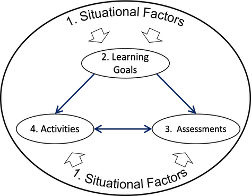
A course plan provides a roadmap for the instructor of what students will learn in class and how class
time will be used effectively to achieve learning. Traditionally, course planning starts with the content, which focuses attention and effort on what the instructor will teach and how they will teach it. In contrast, a more integrated design – a learner-centered approach to course planning – begins with an examination of situational factors and works “backwards” from traditional planning (Figure 1).
How do we do it?
1. Consider situational factors.
Potentially critical factors can inform course design.
Begin with the context of the teaching and learning situation. Fink (2005) suggests answering the following questions:
- How many students are in the class?
- Is the course at the lower division, upper division, or graduate level?
- How long and frequent are the class meetings?
- Will the class be delivered live, online, in a laboratory, etc.?
- What physical elements of the learning environment will affect the class?
Next, it is important to identify characteristics of the learners – life situations, professional goals, prior knowledge and experiences, and expectations of the course.
—
A Deeper Dive into Characteristics of the Learners ...
- Black, Indigenous, and People of Color (BIPOC)
- Black, Indigenous, and People of Color (BIPOC) is an inclusive term which highlights the identities and distinction between Black and Indigenous people, in contrast to other people of color. For more on where the term comes from, see this recent NYT article. On an increasingly diverse campus, such as UC Davis, these students enrich instructional programs and courses. Approximately 79% of all degree-seeking undergraduate students (with known race/ethnicity) at UCD identified as other than White/Caucasian in Fall 2021 (UC Information Center, 2021). Of all US Citizen and Immigrant undergraduate students, 71.8% identified as BIPOC. Classrooms are not culturally-neutral spaces as “students cannot check their sociocultural identities at the door” (Ambrose et al, 2010, p. 169-170). It is therefore crucial that instructors engage in pedagogical practices that acknowledge, celebrate and are inclusive of students with various backgrounds, experiences, and identities. Creating inclusive spaces within the classroom is a vital enterprise that can help ensure that equitable opportunities exist for all students to thrive.
- First-Generation Students
- Upwards of 40% of students enrolled at UC Davis are first-generation students (UC Information Center, 2021). A first-generation student is identified as a US student whose parents/guardians have not received a four-year, US bachelor’s degree (Toutkoushian et al., 2016). While adding their unique perspectives to the institution, first-generation students tend to experience a variety of educational, financial, and social barriers that make successful completion of a bachelor’s degree more difficult in comparison to peers with college educated parents/guardians (Covarrubias & Fryberg, 2015). Pascarella et al. (2004) emphasize the importance of academic and classroom engagement for firstgeneration students. They contend that first-gen students may benefit from their academic experiences comparatively more than their peers with college educated parents/guardians because these experiences build cultural capital they might otherwise not have access to. Research also validates the importance of providing students with resources for accessing academic support, both in and out of the classroom (Brazil-Cruz & Martinez, 2016).
- Transfer Students
- In the Fall of 2021, transfer students accounted for 28.6% of newly enrolled students (UC Information Center, 2021). Transfer students represent a diverse population often from nontraditional backgrounds (i.e., over 25, single parents, part-time) and with diverse life experiences, who contribute unique perspectives to the classroom. Transfer students may have needs and expectations of the university and for their educational experience that are different than their peers entering college directly from high school (Lester, Leonard, & Mathias, 2013). Given the cost savings associated with attending a community college, transferring is a popular option among students from a variety of underrepresented populations, including first-generation students, veteran students, and those from low socioeconomic backgrounds (Durosko, 2017; Fauria & Fuller, 2015). Depending on their life experiences, transfer students may have commitments and responsibilities outside of school that may significantly impact school performance; instructors can help promote success by communicating and being willing to work with transfer students if or when their commitments and responsibilities (e.g., employment schedules, family responsibilities, etc.) interfere with their school commitments and responsibilities.
- International Students
- Increasingly, international students from across the globe are coming to the US, attracted by the highquality education offered at many universities (Turner, 2015). In the 2021-2022 academic year, 15.5% of undergraduate enrollees at UC Davis were international students (UC Davis Information Center, 2021). International students contribute to the diversity of our campus and enrich classroom environments with their unique experiences and perspectives. In addition to the academic challenges international students face, they may also experience a variety of social and cultural challenges as they navigate attending school in a new country. Their transition to attending school in the US can often be overwhelming for international students, who may experience challenges communicating with instructors, staff, and peers. They may also experience culture shock, social isolation, homesickness, and other difficulties adjusting to a new culture (Wu et al., 2015). Instructors can help by providing opportunities for intergroup interactions, such as small group discussions or projects.
- Multilingual Students
- Multilingual students come from a variety of backgrounds in terms of language, culture, immigration/visa status, and time spent living in the US, and this diversity benefits the instructional community. The majority of international students are bi or multilingual, with some having taken English classes throughout their schooling. Others may have limited or interrupted language and literacy instruction in both their home languages and English (e.g., refugees). Another group, common in California, are long-term permanent residents and the children of immigrants (Generation 1.5) who arrived in the US as young children, learning English in the K-12 school system (Menken, 2013). The linguistic backgrounds of multilingual students are often quite varied. Because of their highly varied experiences with English language and literacy instruction, it is important that instructors recognize the individual needs of multilingual students and resist taking a one-size-fits-all approach to the classroom (CCCC, 2014).
After considering the characteristics of the learners, we can couple that with some considerations about ourselves.
- What are our own beliefs and values of teaching and learning?
- What is our teaching philosophy?
- What are our unique strengths and weaknesses as educators?
- What implicit biases may influence our teaching?
- What type of climate do we want to create?
—
A Deeper Dive into Considerations about Ourselves ...
- Our Teaching Philosophy
- A teaching philosophy is one's personal values and beliefs about teaching and student learning. Instructors can have different teaching philosophies and still be highly effective educators. What works in one classroom or with one level of learners may not work in a different context. However, research on education proves the necessity of an inclusivestudent-centered approach. In short, a strong teaching philosophy will: place students at the center of the learning process and focus on student needs and student outcomes. (The Center for Educational Effectiveness provides self-paced modules for how to write Statements of Teaching Philosophy and Diversity Statements.)
- Our Implicit Bias
- Implicit bias is defined as the “attitudes or stereotypes that affect our understanding, actions, and decisions in an unconscious manner. Activated involuntarily, without awareness or intentional control. Can be either positive or negative. Everyone is susceptible” (Kirwan Report, 2017). Within a higher education context, these biases often appear in the form of harmful stereotyping, particularly when it comes to perceived academic ability, identity, or viewpoint. For example, some instructors may unconsciously believe that certain groups are not as capable as others, which may unconsciously influence classroom interactions (Ambrose et al., 2010). All of us can engage in this type of “unthinking discrimination” without even being aware. Still, implicit bias has the potential to impact behavior, yet is malleable and can be “unlearned.” This matters because cumulative effects can translate to: marginalized or under-utilized potential and talent; retention in classes or fields-of-study; and inhibited team work and collaboration (Wilkerson, 2013; Dasgupta, 2013; Roos, et al., 2013).
- Our Classroom Climate
- Classrooms are not culturally-neutral spaces as “students cannot check their sociocultural identities at the door” (Ambrose et al., 2010). It is therefore crucial that instructors engage in pedagogical practices that acknowledge, celebrate and are inclusive of students with various backgrounds, experiences, and identities. This can help ensure that all students have equal opportunities to thrive. Ambrose et al. (2010) note that thinking critically about how your course climate promotes or hinders student learning is important in any classroom.
Course climate is subject to a host of different interacting factors, including:
- faculty-student interaction;
- the tone instructors set;
- instances of stereotyping or tokenism;
- course demographics;
- student-to-student interaction; the range of perspectives represented in the course content and materials.
Taken together, we can use all these types of situational factors to inform the design process.
—
2. Define learning outcome(s) and prioritize which are most important.
Write concrete and measurable learning outcome(s) that describe what students will learn and be able to do by the end of a specific course. As written in a syllabus for Sociology 3 – Social Problems, for example:

There are several benefits to starting with learning outcomes. First, formulating learning outcomes will help you focus what material you will cover during the course. Second, learning outcomes ensure we know what type of understanding we are checking for and that the activities we are doing are purposeful and can help students learn what we want. Third, clearly articulated learning outcomes communicate expectations to students about what they should be able to do by the end of the course. Students may refer back to these learning outcomes to prepare for exams or projects.
—
3. Decide the assessment(s) you will use to check for understanding and achievement.
After you have written your learning outcome(s), determine how students will demonstrate understanding and accomplishment of the outcomes. For example, returning to the previously mentioned learning outcomes (see example from syllabus above), the breadth of assessments for the Sociology 3 – Social Problems course include:

—
A Deeper Dive into Assessment ...
- Writing Effective Test Questions
- Tests and quizzes are among the most prevalent forms of assessment instruments in use on college campuses. Whether summative (assessment of student learning at the conclusion of a unit, course, or program) or formative (assessments meant to provide timely and effective feedback during the term or class), tests and quizzes represent a key form of information for students and instructors about learning in the classroom (McKeachie & Svinicki, 2013). Research suggests that while welldesigned multiple-choice questions (MCQs) can be used to assess multiple dimensions of Bloom’s Cognitive Process Domains, most MCQ tools focus on lower-order skills like remembering and understanding (Momsen et al., 2010). However, well-constructed MCQs can be used to assess higherlevel thinking such as “apply” or “analyze,” by asking students to apply course concepts through realistic problems or scenarios (Freeman et al., 2011).
- Providing Effective Feedback
- A primary purpose of effective feedback is to help students learn, so it’s important that students get feedback as part of an ongoing formative process in which they have the opportunity to implement changes (Shute, 2008). Forms of feedback vary and may include a completed rubric grid or written comments on a problem set or draft paper. Effective feedback can lead to more self-directed and autonomous learners, thinkers, and engaged members of society. Research has shown that the most effective feedback is focused, forward-looking, and timely (Ambrose, et al. 2010; Hyland, 2013). Feedback should be formative, communicating how students are doing in relation to stated learning outcomes/goals, and what specific steps they should take to improve. They should then be expected to demonstrate how they incorporated the feedback into subsequent assignments. Students should receive feedback that is both frequent and timely (Hyland, 2013; Wiggins, 2012). Feedback that shares with students where and/or why they are succeeding, as well as how they might improve, motivates students to learn – the primary purpose of effective feedback.
—
4. Determine the classroom activities that you will use to help students acquire the skills and knowledge needed to successfully demonstrate mastery of the learning outcome(s).
Activities should engage learners with the content, with peers, and with you. Examples and adaptations for online learning:
Activities that Actively Engage Students
- Pause for Reflection
- During lecture, particularly after presenting an important point or key concept, pause to allow students to think about the information or check their notes to identify points that may be unclear. You might also write general “pause for reflection” questions and share them with your students. This is one way you can encourage your students to reflect upon and synthesize what they have just learned.
Adapted for Online Learning: Pause during a mini-lecture or Zoom presentation. - Minute Paper
- Ask students to spend a minute (or a few minutes) writing short responses to a question or questions meant to gauge their understanding of a class concept. Afterwards, students can share verbally in a whole class discussion, post their response to a discussion board, submit their response as a Canvas assignment, or share during study or discussion session.
Adapted for Online Learning: You could also use a similar activity during online office hours. For example, if you have several students in your Zoom room at once, you could direct Student A to take a couple of minutes to try to write out a response to a question they have while you conference with Student B. Then, you can have Student A “unmute” themselves and verbally debrief their answer with them. - Muddiest Point
- Towards the end of a lecture or lab session, ask students to write a short note explaining which point from that day’s class or the unit is most unclear to them. Use this feedback from students to inform how you teach or review the next class.
Adapted for Online Learning: Try the same strategy for a mini-lecture video or an online module. If you lead online discussion sections, you might ask students to post these comments to a discussion board or email them to you prior to your discussion session, so that you can address these areas in your session. Even if you aren’t leading any sort of live session, you might ask the students in your sections to post or email “muddiest points” to you weekly, and then prepare a short clarifying video or handout based on their responses. - Think/Write-Pair-Share
- For this activity, pose a question and give students a few minutes to think about the question and then write down their response. Then have students pair up and share their ideas. This is a good strategy to keep students focused and engaged during long lectures.
Adapted for Online Learning: You can do pairing activities on Zoom via break-out rooms during synchronous meetings. Students can also share responses via text, email, or the Canvas discussion feature with other students in the class. - “You are the professor” Question Creation
- Assign groups to create questions that help check for understanding of concepts. Students can do this during discussion sections or outside of class via a shared Google doc through the “Collaborations” tab on Canvas. If they come up with good questions, you might incorporate them as possible exam questions or questions for a study guide.
Adapted for Online Learning: You can do the same activity synchronously via Zoom in breakout rooms or asynchronously with Google docs. - Role playing
- Ask students to “act out” a position or argument to get a better idea of the concepts and theories being discussed. Role-playing exercises can range from the simple to the complex (e.g., skeptic, community member, scientist, historical figure, etc.). Volunteers can do this during a lecture, where you can provide feedback for the entire class. This is also a good activity for discussion session.
Adapted for Online Learning: While you can do this via Zoom, you could alternatively ask students to record and submit videos of them speaking from the perspective of the assigned role. If you choose to do this, keep in mind that students will have varying degrees of access and familiarity with technology. It would be wise to provide an alternative activity if they are unable to produce a video such as submitting a script or a “letter to the editor” written from the perspective of that role. - Jigsaw Discussion
- Divide the class into small groups, each of which is assigned a different task. For example, each group might be asked to summarize the key points of one article or solve a different equation. Each group completes their task. Then, new groups are formed, each composed of one member from each of the original groups (so all group members in the new group have completed a different task). Students then take turns presenting their work to the rest of the group. In this exercise, each student is an ‘expert’ in one task and exposed to all other tasks. This is an ideal way to expose students to many different readings, whereby students learn from their peers about myriad readings and teach their peers about the one they have read and have “expertise.”
Adapted for Online Learning: Again, you could also facilitate this activity synchronously using breakout groups via Zoom or asynchronously via shared Google docs. - Experiential Learning
- Online content and a series of online learning activities are created to guide students, alone and in groups, to see/experiment, learn, compare, critique, share, and apply. Experiential learning activities include online/virtual field trips, study abroad, internships/apprenticeships, practicums, service learning, peer/student teaching, and volunteer experiences. With technology in class, student can explore sites you have curated as rich for learning your content.
Finally, check for alignment and integration by ensuring that assessments and activities will help students achieve the learning outcomes. These integrated components work to support and reinforce each other.
Appendix 1 describes a Framework for Transparency in Course and Lesson Design and includes applied examples. Appendix 2 presents a planning template that synthesizes all four components of Integrated Design and can be used for planning a face-to-face course, while Appendix 3 presents a planning template for use in transitioning to a remote/online course. Appendix 4 is an extract of the first two pages of the UC Diversity, Equity, and Inclusion Course Design Rubric, with particular focus on the “Syllabus and General Course Design” dimension.
- Acknowledgements
- This resource was developed with the input of Monica Esqueda, Program Manager for Betty Irene Moore School of Nursing. Appendix 1 was adapted from a CEE workshop, Transparency in Teaching, facilitated by Rachel Stumpf (PhD, Education Specialist, Center for Educational Effectiveness). Barbara Mills (MA, Evaluation Specialist, Center for Educational Effectiveness) provided additional feedback.
- Additional Readings & Resources
- → For a video about Situational Factors in Learning
→ For information and resources about assessment process Student Learning Outcomes Assessment
→ For more information and examples about transparency in teaching and learning from TILT Higher Ed
→ Read more information about Syllabus Design with “Cruelty-Free Syllabi” by Matthew Cheney
→ Review your syllabi for equity using the Syllabus Review tool from the Center for Urban Education - Citation
- Center for Educational Effectiveness [CEE]. (2022). Course Design Series. Just-in-Time Teaching Resources. Retrieved from http://cee.ucdavis.edu/JITT
- References
- Ambrose, S. A., et al. (2010). How learning works: Seven research-based principles for smart teaching (pp. 66–90). San Francisco, CA: Jossey-Bass.
Brazil-Cruz, L., & Martinez, S. S. (2016). The importance of networking and supportive staff for Latina/o first-generation students and their families as they transition to higher education. Association of Mexican American Educators Journal, 10(1), 129–158.
Conference on College Composition and Communication [CCCC]. (2001/2014). CCCC statement on second language writing and writers. Retrieved from http://www.ncte.org/cccc/resources/positions/secondlangwriting
Covarrubias, R., & Fryberg, S. A. (2015). Movin’ on up (to college): First-generation college students’ experiences with family achievement guilt. Cultural Diversity and Ethnic Minority Psychology, 21(3), 420–429. https://doi.org/10.1037/a0037844
Dasgupta, N. (2013). Implicit attitudes and beliefs adapt to situations: A decade of research on the malleability of implicit prejudice, stereotypes, and the self-concept. Advances in Experimental Social Psychology, 47, 233–279. https://doi.org/10.1016/B978-0-12-407236-7.00005-X
Durosko, H. (2017). Five ways to support veteran transfer students. Journal of College Admission, 235, 42–43.
Fauria, R. M., & Fuller, M. B. (2015). Transfer student success: Educationally purposeful activities predictive of undergraduate GPA. Research & Practice in Assessment, 10, 39–52.
Fink, L. D. (2005). Integrated course design. Idea Paper #42, 1–7. Manhattan, KS: The IDEA Center.
Freeman, S., Haak, D., & Wenderoth, M. P. (2011). Increased course structure improves performance in introductory biology. CBE—Life Sciences Education, 10(2), 175–186. Retrieved from http://www.lifescied.org/content/10/2/175.short
Hyland, K. (2013). Student perceptions of hidden messages in teacher written feedback. Studies in Educational Evaluation, 39(3), 180–187. https://doi.org/10.1016/j.stueduc.2013.06.003
Engle, J., & Tinto, V. (2008). Moving beyond access: College success for low-income, first-generation students. Pell Institute. Retrieved from http://files.eric.ed.gov/fulltext/ED504448.pdf
Kirwan Institute. (2017). State of the science: Implicit bias review.
Lester, J., Brown Leonard, J., & Mathias, D. (2013). Transfer student engagement: Blurring of social and academic engagement. Community College Review, 41(3), 202–222. https://doi.org/10.1177/0091552113487931
McKeachie, W., & Svinicki, M. (2013). McKeachie’s teaching tips. Belmont, CA: Cengage Learning.
Menken, K. (2013). Emergent bilingual students in secondary school. Language Teaching, 46(4), 438–476. https://doi.org/10.1017/S0261444813000268
Momsen, J. L., Long, T. M., Wyse, S. A., & Ebert-May, D. (2010). Just the facts? CBE—Life Sciences Education, 9(4), 435–440. Retrieved from http://www.lifescied.org/content/9/4/435.short
Pascarella, E. T., Pierson, C. T., Wolniak, G. C., & Terenzini, P. T. (2004). First-generation college students. The Journal of Higher Education, 75(3), 249–284. https://doi.org/10.1080/00221546.2004.11772256
Roos, L. E., Lebrecht, S., Tanaka, J. W., & Tarr, M. J. (2013). Can singular examples change implicit attitudes in the real world? Frontiers in Psychology, 4, 594. https://doi.org/10.3389/fpsyg.2013.00594
Shute, V. J. (2008). Focus on formative feedback. Review of Educational Research, 78(1), 153–189. https://doi.org/10.3102/0034654307313795
Toutkoushian, R. K., Stollberg, R. A., & Slaton, K. A. (2018). Talking 'bout my generation. Teachers College Record, 120(4).
Turner, C. (2015). U.S. colleges see a big bump in international students. NPR. Retrieved from http://www.npr.org/sections/ed/2015/11/18/456353089/u-s-colleges-see-abigbump-in-international-students
University of California Information Center. (2021). Fall enrollment at a glance. Retrieved from https://www.universityofcalifornia.edu/about-us/information-center/fall-enrollment-glance
Wiggins, G. (2012). Seven keys to effective feedback. Educational Leadership, 70(1), 10–16.
Wilkerson, I. (2013). No, you’re not imagining it. Essence, 44, 132–137.
Wu, H. P., Garza, E., & Guzman, N. (2015). International student’s challenge and adjustment to college. Education Research International, 2015, 1–9. https://doi.org/10.1155/2015/202753