


Encouraging Student Motivation Series: Topic Intro | Part 1 | Part 2 | Part 3
Encouraging Student Motivation Series
Part 1:
Motivation in the Classroom
Overview
Motivation is perhaps the most critical non-academic factor to positively affect student performance on coursework (Ambrose et al., 2010; Lotkowski, Robbins, & Noeth, 2004). Increased motivation has been linked to increased academic achievement (Paulsen & Feldman, 1999), success in handling stressful situations (Struthers, Perry, & Menec, 2000), and better study skills (Robbins et al., 2004).
—
Intrinsic and Extrinsic Motivation
Ryan & Deci (2000) explain that sources of student motivation tend to fall into two broad categories:
- Extrinsic motivation: grades, degree requirements, competition, family pressure, incentives
- Intrinsic motivation: genuine interest, personal learning goals, relevance to learner
The various social and cultural contexts that a student experiences, from their personal background to the new contexts they encounter in the university, have the potential to affect the types of motivation they experience. Intrinsic and extrinsic motivation are also potentially reinforcing; research has shown that students who start out with solely extrinsic motivation for a course can develop intrinsic motivation as they gain competence in the subject matter (Hidi & Renninger, 2006). For historically minortized students, a recent study by Hernandez et al. (2013) indicates that a desire to develop competence rather than demonstrate performance (which is strongly related to intrinsic motivation) predicted increased GPAs for African-American and Latinx students. At the same time, social psychologists have argued that an approach that places undue value on intrinsic motivation may be tied too strongly to individualistic societies (Cohen et al., 2005).
—
How is motivation tied to relevancy?
There is often a disconnect between the value instructors and students see in a course. Being aware of this need to establish value for students can benefit the learning process. Consider when, how, and at what frequency you strive to establish value. In fact, Ambrose et al. (2010) describe the interactive effects of environment, efficacy, and value on student motivation. These relationships are depicted in the figure below.
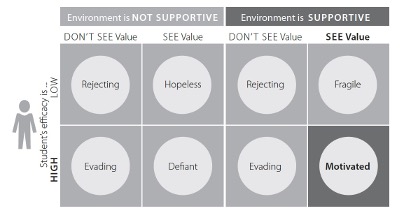
Linking coursework to student interests can increase intrinsic motivation and help improve student performance (Ambrose et al., 2010). Emphasizing the relationship between coursework and students’ daily lives, real-world tasks, or academic/professional lives can be especially motivating for students.
Research-based strategies and examples that can establish value and motivate your students:
| Strategies | Activity Examples |
| Consider connecting material to students’ existing interests. For example, you could link the topic to pop culture or current events. | American History example: Discuss changing political campaign techniques between the past and present. Pull video excerpts from recent campaign speeches and have students identify the central issue being discussed and what type of persuasive technique is being used. |
| Try to make course material real-world relevant. For example, you could create practical assignments that might be useful in daily life. | Engineering Example: Ask the class how many bikes a UNITRANS bus can hold at full capacity and follow up with the question, “How would you most efficiently expand that number?” |
| Illustrate how the material can transfer across subjects. For example, you could make explicit connections with other classes or areas of interest. | Psychology example: Discuss memory structures in class and have students practice techniques to help improve memory. Ask students how these techniques could help them in their other classes, and prompt them to try the techniques in at least one other class and record their results. |
As an Emerging Hispanic Serving Institution (for more on HSI status, visit UCD’s website here) – where nearly 25% of our undergraduate student enrollment is Hispanic – we are reminded of the scholarship around mindset. Relating instruction to relevant aspects of all students’ lives requires a more strengthsbased approach or an asset-orientation. As described by Byron P. White (2019), a “Rising Scholars” framework focusing on the gifts, talents, and contributions that students bring with them to the university, affords the opportunity for their potential to be realized. Other scholarship similarly supports the value of a growth mindset. Canning et al. (2019) found that STEM instructors who believed that ability was fixed not only inspired less student motivation but also suffered larger racial achievement gaps. In this study, faculty mindset beliefs predicted student motivation and achievement greater than any other faculty characteristic.
The Case for Relating Learning to Future Work and Employment
One of the simplest, but often forgotten, ways to make learning relevant to students is by connecting the skills they learn in the class, with the skills they will use in the workplace after they graduate. These skills are concerned less about course content and more about course processes. Aligning course learning objectives with skills that employers seek, can create student motivation from day one. Examples of such skills include the ability to think critically, to analyze data, to communicate effectively, to collaborate in teams, or to consider diverse perspectives. In a very recent study, researchers say employers identified critical thinking, problem solving, and written communication as the most valued but weakest skills as graduates enter the workforce (Rose & Flateby, 2022). For more, see the AAC&U report on this 2021 study, How College Contributes to Workforce Success, here.
—
How can I demonstrate my enthusiasm for the topic?
Sharing your enthusiasm for a subject can inspire student interest and motivation to learn. Adopting a personable and engaging classroom manner can help pique student interest in coursework and help students to meet learning objectives (Allen, Witt, & Wheeless, 2006). Students who have several positive interactions with faculty are more likely to have high levels of satisfaction with their college experience (Astin, 1984). Here are a few suggestions for communicating your enthusiasm positively to a class:
| Strategies | Discussion Examples |
| Make yourself more approachable by sharing positive, relevant, and appropriate examples from your life with the class. | These examples should help to connect course concepts with the “real world” be demonstrating your own experiences with these concepts. |
| Consider starting a conversation with your students about what first attracted you to your field; then, encourage them to discuss what attracted them to the field. | Art example: As a child, my favorite type of books to read were comic books. My favorite issue was by an artist who combined watercolor with photographs to create collages for each panel. I wanted to know how they’d done it, so I picked up a camera to start figuring it out. What drew you to photography? |
| Make classwork active and engaging by switching up activities and lecture. This can help prevent your class from becoming monotonous. | Medical example: Pass out cups of water - don’t let students drink them! In some of the cups, place a few drops of one non-toxic chemical reagent. Ask students to form small groups and have one student pour a bit of their water into the others’ cups. Switch up the groups and repeat three times. Walk around and place one drop of the trigger reagent in each cup. The cups that have been “infected” will turn red. Ask students to trace the path of infection and use this as a springboard to discuss transmission vectors. |
- Additional Resources
-
- On integrating effective classroom practices, visit the CEE teaching support website
- For academic technology support, visit Academic Technology Services
- For the TA handbook and instructional materials, visit the CEE’s TA orientation webpage
- Citation
- Center for Educational Effectiveness [CEE]. (2022). Encouraging student motivation series. Just-in-Time Teaching Resources. Retrieved from https://cee.ucdavis.edu/JITT
- References
- Allen, M., Witt, P. L., & Wheeless, L. R. (2006). The role of teacher immediacy as a motivational factor in student learning: Using meta-analysis to test a causal model. Communication Education, 55(1), 21–31. https://doi.org/10.1080/03634520500343368
Ambrose, S. A., et al. (2010). How learning works: Seven research-based principles for smart teaching. San Francisco, CA: Jossey-Bass.
Astin, A. W. (1984). Student involvement: A developmental theory for higher education. ResearchGate, 40, 518–529.
Canning, E., Muenks, K., Green, D., & Murphy, M. (2019). STEM faculty who believe ability is fixed have larger racial achievement gaps and inspire less student motivation in their classes. Science Advances, 5, 1–7.
Deci, E. L., Koestner, R., & Ryan, R. M. (1999). A meta-analytic review of experiments examining the effects of extrinsic rewards on intrinsic motivation. Psychological Bulletin, 125(6), 627.
Hernandez, P. R., Wesley, P., Estrada, M., Woodcock, A., & Chance, R. C. (2013). Sustaining optimal motivation: A longitudinal analysis of interventions to broaden participation of underrepresented students in STEM. Journal of Educational Psychology, 105(1), 89–107.
Hidi, S., & Renninger, K. A. (2006). The four-phase model of interest development. Educational Psychologist, 41(2), 111–127.
Lotkowski, V. A., Robbins, S. B., & Noeth, R. J. (2004). The role of academic and non-academic factors in improving college retention. ACT Policy Report. American College Testing ACT Inc.
Paulsen, M. B., & Feldman, K. A. (1999). Student motivation and epistemological beliefs. New Directions for Teaching and Learning, 1999(78), 17–25. https://doi.org/10.1002/tl.7802
Robbins, S. B., Lauver, K., Le, H., Davis, D., Langley, R., & Carlstrom, A. (2004). Do psychosocial and study skill factors predict college outcomes? A meta-analysis. Psychological Bulletin, 130(2), 261–288. https://doi.org/10.1037/0033-2909.130.2.261
Rose, T. A., & Flateby, T. L. (2022, July 15). From college to career success. Inside Higher Ed. https://www.insidehighered.com/views/2022/07/15/employers-recent-grads-rate-their-skillsopinion
Ryan, R. M., & Deci, E. L. (2000). Intrinsic and extrinsic motivations: Classic definitions and new directions. Contemporary Educational Psychology, 25(1), 54–67.
Struthers, C. W., Perry, R. P., & Menec, V. H. (2000). An examination of the relationship among academic stress, coping, motivation, and performance in college. Research in Higher Education, 41(5), 581–592. https://doi.org/10.1023/A:1007094931292
White, B. P. (2016, April 19). Beyond a deficit view. Inside Higher Ed. https://www.insidehighered.com/views/2016/04/19/importance-viewing-minority-low-incomeand-first-generation-students-assets-essay